AI can move fast. The system still has to be right.
AI can help research, design, build, test, and revise technical work quickly.
Our method keeps that speed connected to clear decisions, meaningful evidence, and the job the system actually needs to perform.
START WITH THE JOB.
Before choosing tools, models, or architecture, we establish what needs to happen and what must remain true.
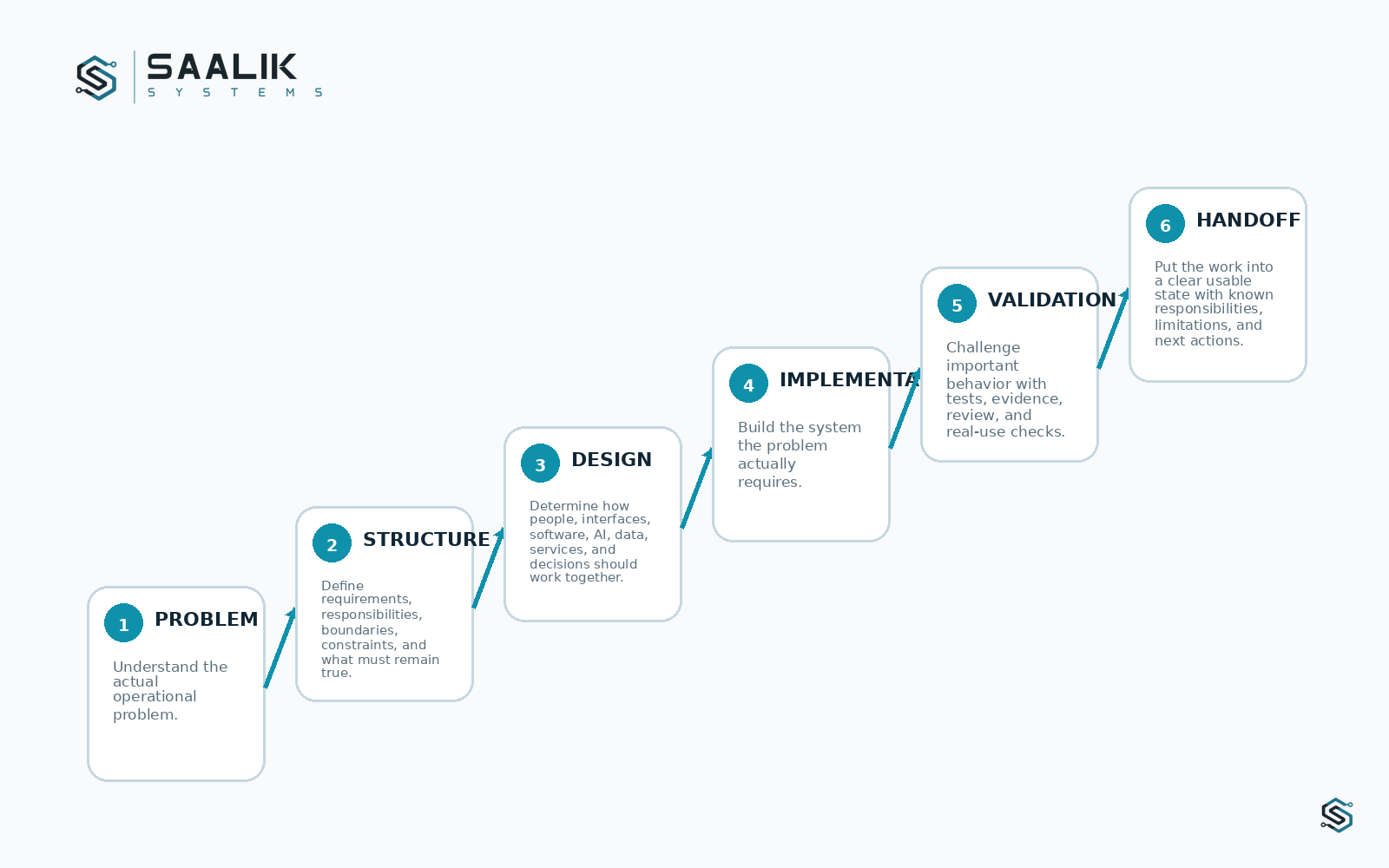
A project may move through every stage or compress several of them.
The sequence exists to keep the work connected to the problem—not to create process for its own sake.
SYSTEM FIRST. TOOL SECOND.
KEEP AUTHORITY VISIBLE.
AI can contribute capability without becoming the authority over what the system is supposed to be.
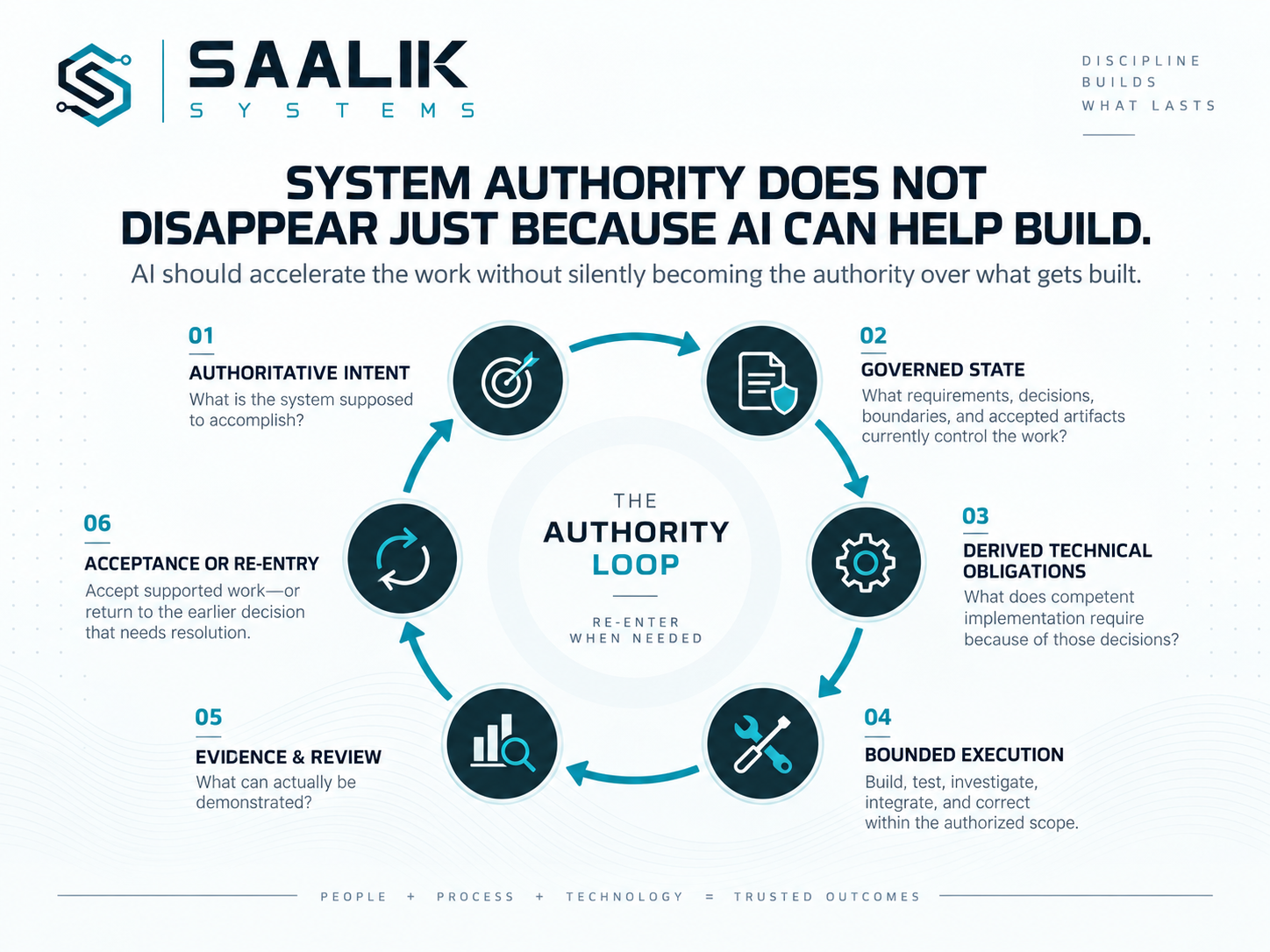
Material decisions stay explicit.
Execution stays bounded by those decisions.
Evidence can support acceptance—or show us where the work needs to return upstream.
TEST THE CLAIMS THAT MATTER.
Working once is not the same thing as working correctly.
Important behavior should have evidence appropriate to its consequence.
That may mean testing recovery, retries, state, validation, boundaries, failure behavior, or the real operating conditions the system will face.
The goal is not maximum testing.
It is enough evidence to trust the claims that matter.
CONTROL PROPORTIONAL TO CONSEQUENCE.
A typography adjustment and an authentication boundary do not need the same level of control.
Higher-consequence decisions deserve stronger boundaries, evidence, and acceptance.
Lower-consequence work should remain lightweight.
CONTROL PROPORTIONAL TO CONSEQUENCE.
BUILD ONLY WHAT THE PROBLEM REQUIRES.
Good architecture is not measured by how much technology it contains.
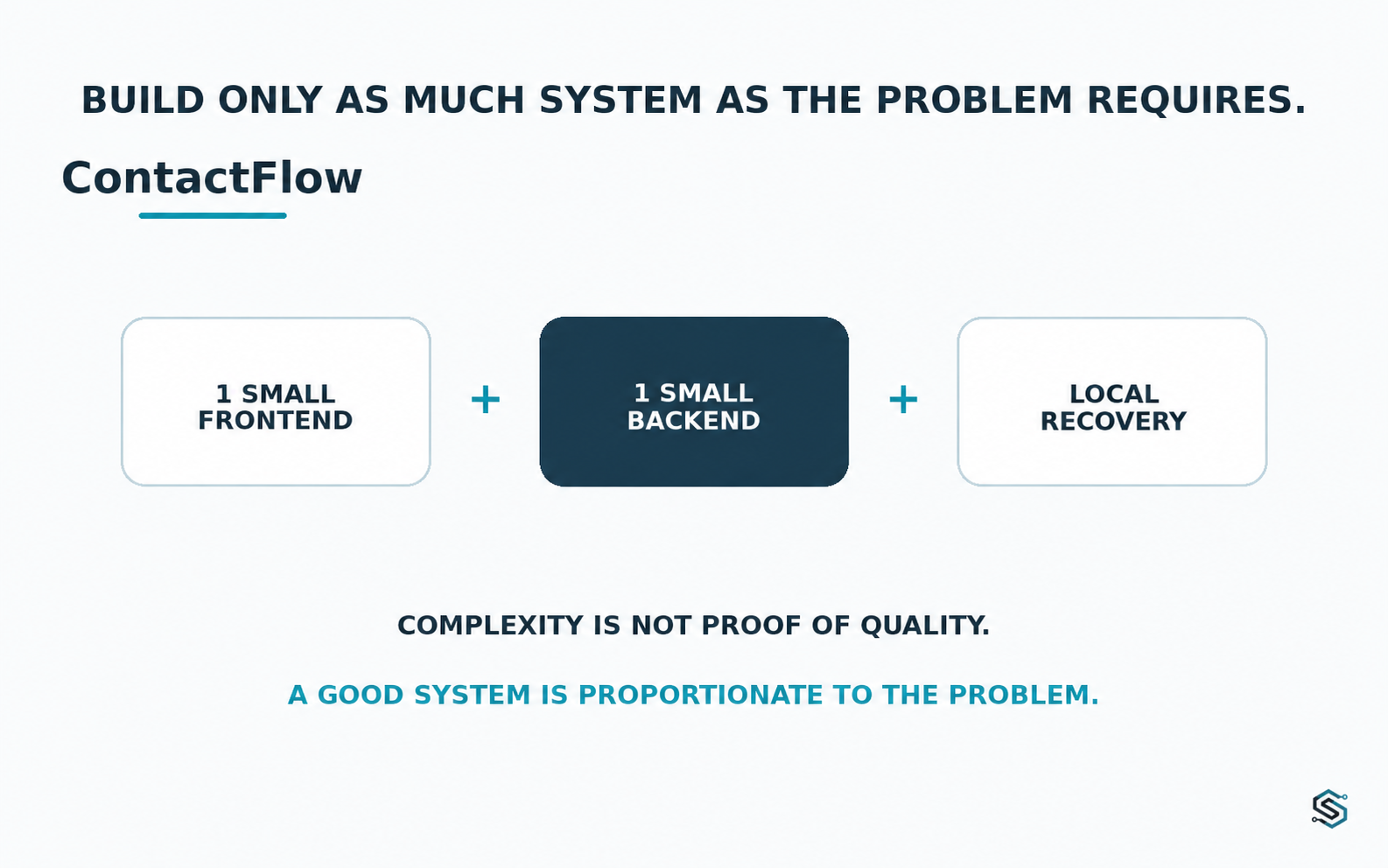
A focused application may need only a few well-chosen pieces.
A larger product may require deeper state, recovery, integrations, and service boundaries.
Both can be correct.
COMPLEXITY IS NOT PROOF OF QUALITY.
WHAT THIS MEANS FOR YOUR PROJECT
Controlled development helps us:
- keep the objective clear;
- catch unresolved decisions before they become implementation assumptions;
- test consequential behavior;
- correct the part that actually failed;
- preserve what already works;
- and leave the system in a state that can be understood and continued.
That is the point of the method.
THE DEEPER RESEARCH
Governed Context Architecture is the separate research and method body behind deeper work on authority, project state, bounded AI roles, auditing, traceability, and controlled correction.
Jamaal Saalik Belt-Daniels develops part of that thinking in Authority Beyond Expertise.
READ AUTHORITY BEYOND EXPERTISE (opens in a new tab)
HAVE A PROBLEM WORTH BUILDING AROUND?
Start with what is happening now and what needs to happen instead.
We can work forward from there.